Dr. Kai Liu
Tenured Full Professor
Tsinghua University
Department of Chemistry
E-mail: kailiu@tsinghua.edu.cn
Dr. Kai Liu is a professor in the Department of Chemistry of Tsinghua University in Beijing, where he is heading a laboratory performing research on protein engineering and material synthetic biology. He earned his PhD degree from the University of Groningen in The Netherlands and he pursued his postdoctoral studies at Harvard University in the USA. In 2017 he was appointed as a principal investigator at Changchun Institute of Applied Chemistry of the Chinese Academy of Sciences. In 2020, he moved to Tsinghua University and in 2023 he was elevated to the position of tenured full professor. He is serving as the chief scientist for a National Key R&D Program of China on biomanufacturing protein materials. He has been given several talent awards including Beikun Young Scientist Award, CCS Excellent Young Chemist AwardBeijing Zhongguancun Award for Outstanding Young Scientists, Rubicon Award from Netherlands Organization for Scientific Research, National Science Fund for Distinguished Young Scholars from China, Young Innovator Award of the journal Nano Research, CCS Chemical Biology Young Investigator Award. Besides, he is serving as an Associate Editor for the journal ACS Biomaterials Science & Engineering.
Research areas and interests
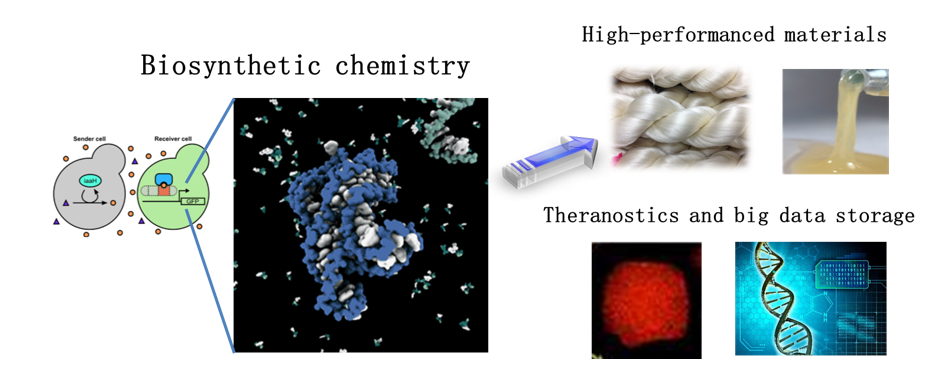
We are focusing on biological synthesis and the production of scale-up functional biomaterials. Structural proteins are designed as building blocks for ultra-strong biomaterials for high-tech applications are explored. We are also performing research on the interface of biotechnology and information technology.
Total publications >200, recent publications (with *)
1. Charge-Driven Bioshield Remodels Diabetic Oral Microenvironment for Accelerated Wound Healing, Adv. Mater., 2026, e16778.
2. Biomanufacturing of Advanced Materials Driven by Synthetic Biology, CCS Chem., 2026, 8, 164.
3. Genetically Encoded Design and Biomanufacturing of Mechanical Protein Materials, Acc. Mater. Res., 2026, 7, 58–71.
4. Liquid crystal–guided DNA information storage: Nondestructive recovery and long-term preservation, Sci. Adv., 2025, 11, eadu3957.
5. Temporal Immunomodulatory Hydrogel Regulating the Immune-Osteogenic Cascade for Infected Bone Defects Regeneration, Adv. Mater., 2025, e14419.
6. Nanoshield Architecture Harnessing Neoantigen-Targeting Peptides Enables Durable Post-surgical Glioma Immunotherapy, Nano Lett., 2025, 25, 13629–13638.
7. In Situ Ultrasound-Triggered Bioluminescence for Combined Sono/Photodynamic Immunotherapy, ACS Nano, 2025, 19, 26791–26804.
8. Modulation of Near-Infrared Afterglow Luminescence in Inorganic Nanomaterials for Biological Applications, Adv. Mater., 2025, 2419349.
9. Phytochlorin-Based Sonosensitizers Combined with Free-Field Ultrasound for Immune-Sonodynamic Cancer Therapy, Adv. Mater., 2025, 2410559.
10. Dynamic Peptide Nanoframework-Guided Protein Coassembly: Advancing Adhesion Performance with Hierarchical Structures, J. Am. Chem. Soc., 2025, 147, 2335−2349.
11. Flexible Sono–Piezo Patch for Functional Sweat Gland Repair through Endogenous Microenvironmental Remodeling. ACS Nano, 2024, 18, 20283–20295.
12. Multi-Functional Lanthanide Metallopolymer: Self-Healing and Photo-Stimuli-Responsive Dual-Emitting Luminescence for Diverse Applications. Adv. Mater., 2024, 36, 2405164.
13. A Hydroxylamine-Mediated Amidination of Lysine Residues That Retains the Protein’s Positive Charge. Angew. Chem. Int. Ed., 2024, 63, e202402880.
14. Customized Proteinaceous Nanoformulation for In Vivo Chemical Reprogramming. Adv. Mater., 2024, 2311845.
15. Modular Protein Fibers with Outstanding High-strength and Acid-resistance Performance Mediated by Copper Ion Binding and Imine Networking. Adv. Mater., 2024,2400544.
16. Spidroin-mimetic Engineered Protein Fibers with High Toughness and Minimized Batch-to-batch Variations through β-sheets Co-assembly. Angew. Chem. Int. Ed., 2024, 63, e202400595.
17. Superstrong and tough DNA bulk fibers via metal ion-induced multiscale engineering. Matter, 2024, 7, 963-976.
18. Biomimetic Structural Proteins: Modular Assembly and High Mechanical Performance, Acc. Chem. Res., 2023, 56, 19, 2664–2675.
19. Protein fibers with self-recoverable mechanical properties via dynamic imine chemistry. Nat. Commun., 2023, 14, 5348.
20. Contribution of Hydrogen Bond Nanoarchitectonics to Switchable Photo-Thermal-Mechanical Properties of Bio-inorganic Fibers, CCS Chem., 2023, 5, 1242.
21. Molecularly engineered protein glues with superior adhesion performance, Adv. Mater., 2022, 34, 2204590.
22. Molecular Engineered Crown-Ether–Protein with Strong Adhesion over a Wide Temperature Range from -196 to 200°C, Angew. Chem. Int. Ed., 2022, e202207425.
23. In vivo processing of digital information molecularly with targeted specificity and robust reliability, Sci. Adv., 2022, 8, eabo7415.
24. Engineering high strength and super toughness of unfolded structural proteins and their extraordinary anti-adhesion performance for abdominal hernia repair, Adv. Mater., 2022, 34, 2200842.
25. Highly stiff and stretchable DNA liquid crystalline organogels with super plasticity, ultrafast self-healing and magnetic response behaviors, Adv. Mater., 2021, 34, 2106208.
26. Ultra-strong bio-glue from genetically engineered polypeptides, Nat. Commun., 2021, 12, 3613.
27. Genetically engineered polypeptide adhesive coacervates for surgical applications, Angew. Chem. Int. Ed., 2021, 60, 23687.
28. Significantly improving the bioefficacy for rheumatoid arthritis with supramolecular nanoformulations, Adv. Mater., 2021, 33, 2100098.
29. An artificial phase‐transitional underwater bioglue with robust and switchable adhesion performance, Angew. Chem. Int. Ed., 2021, 60, 12082.
30. Improving Bioavailaibity of Hydrophobic Prodrugs through Supramolecular Nanocarriers based on Recombinant Proteins for Osteosarcoma Treatment, Angew. Chem. Int. Ed., 2021, 60, 11252.
31. Reversibly photo-modulating mechanical stiffness and toughness of bioengineered protein fibers, Angew. Chem. Int. Ed., 2021, 60, 3222.
32. Anisotropic protein organofibers encoded with extraordinary mechanical behaviors for cellular mechanobiology applications, Angew. Chem. Int. Ed., 2020, 59, 21481.
33. De novo rational design of a freestanding, supercharged polypeptide, proton conducting membrane, Sci. Adv., 2020, 6, eabc0810.
34. Bio‐inspired and Mechanically Strong Fibers Based on Engineered Non‐Spider Chimeric Proteins, Angew. Chem. Int. Ed. 2020, 59, 8148.
35. Engineered Near-Infrared Fluorescent Protein Assemblies for Robust Bioimaging and Therapeutic Applications, Adv. Mater. 2020, 32, 2000964.
36. Biocompatible and pH‐Responsive Colloidal Surfactants with Tunable Shape for Controlled Interfacial Curvature, Angew. Chem. Int. Ed., 2020, 59, 9365.
37. Mechanically strong globular protein-based fibers via microfluidic spinning technique, Angew.Chem. Int. Ed., 2020, 59, 4344.
38. Solvent-free plasticity and programmable mechanical behaviors of engineered proteins, Adv. Mater., 2020, 32, 1907697.
39. Fabrication and mechanical properties of engineered protein-based adhesives and fibers, Adv. Mater., 2020, 32, 1906360.
40. Proteinaceous fibers with outstanding mechanical properties manipulated by supramolecular interactions, CCS Chem., 2020, 3, 1669.